I. Provenance & Chain of Custody
The Artifact Drives preserve an unbroken and independently verifiable chain of custody spanning more than fifteen years. Every file, directory, timestamp, and system artifact across all drives has been conclusively linked to one owner, one user profile, and one daily user. This singular control is confirmed through forensics of login histories, profile creation dates, hardware identifiers, and time‑anchored system usage patterns.
These were the owner's personal laptops, used continuously from 2008–2015 for work, family media, email, browsing, software development, and Bitcoin experimentation. Because the machines were never transferred, loaned, or shared, the resulting digital environment forms an authentic "closed ecosystem" — an ideal forensic environment for verifying provenance and early Bitcoin activity.
Beyond operating‑system artifacts, the primary collection consists of more than 3,000 fully authenticated Satoshi‑era Bitcoin files — the rarest class of surviving digital artifacts from Bitcoin’s first years. These include complete, timestamp‑verified developer source trees, never‑released experimental builds, early GUI clients with embedded wallets, and Laszlo Hanyecz’s original 2010–2011 makefiles for Linux, Unix, macOS, and Windows — each showing identical triple‑stamped dates from January 2010 and still containing his personal email address inside the source code. Also preserved are pure BDB wallet.dat files from 2009–2012 with verifiable on‑chain histories exceeding 7,000 BTC in cumulative flows, along with pristine blkindex.dat and blk0000.dat ledger files in their unrevised, pre‑LevelDB state. All of these artifacts exist exactly as they were originally written to disk — untouched, unmodified, and impossible to fabricate — forming an irreplaceable, museum‑grade record of Bitcoin’s creation, evolution, and early developer activity.
All findings to date confirm 100% provenance integrity. Any acquisition partner — institutional or private — may validate this independently using their own forensic analysis teams. The environment they will examine has remained untouched since its original period of use, creating a museum‑grade Satoshi‑era digital time capsule.
I‑A. The Origin Story — A Window Into Bitcoin’s Dawn
To understand the magnitude of this collection, one must step back into the world that existed when Bitcoin was not a global phenomenon, but an idea shared among a handful of pioneers. These files are not merely data — they are living timestamps from the earliest days of a monetary revolution, preserved unintentionally yet perfectly, inside the ordinary digital life of a single individual who downloaded them when Bitcoin itself was still a whisper in the dark.
Imagine it: the year is 2009. A personal laptop sits on a desk — cluttered with family photos, work documents, Napster downloads, iTunes playlists, emails, memories, life. And beside them, silently accumulating, are the raw components of a new financial universe: primitive GUIs, embryonic source trees, handwritten developer notes, unreleased executables, and the original wallet.dat structures that would one day move thousands of Bitcoin when the world still hadn’t realized what a Bitcoin was worth.
These files were not curated or constructed. They were not cloned, collected, or recreated. They were lived with. They grew on the drives the same way photos of children, work presentations, and music libraries did — naturally, over time, with no intent or expectation that they would one day become priceless. This is what gives the archive its power: it is not a reconstruction. It is the environment itself, frozen exactly as it existed when Satoshi Nakamoto still walked among the mailing lists.
When a modern reader encounters this collection, their mind’s eye should be transported — not to the abstract history written in blogs or documentaries, but into the real rooms where early Bitcoin ran, compiled, crashed, updated, and evolved. These drives are a time machine. They reconnect us to the moment the global financial system began to shift — quietly, privately, on machines just like these. And now, for the first time, that entire lived environment is preserved, verifiable, and ready for the world to witness.


I. Asset Authority
II. The Collection — Early Bitcoin Development Archive
This archive contains one of the most comprehensive, untouched collections of pre‑2012 Bitcoin materials known to exist. It includes experimental GUIs, timestamped development binaries, pre‑LevelDB block files, source trees, and wallet structures preserved exactly as they existed on the original hardware. The environment in which these artifacts were discovered reflects an uninterrupted digital life of a single user — making manipulation or fabrication impossible.
This artifact represents just one of the many hyper ultra rare and historically signifiant bitcoin wallets from the Satoshi-era with valid key/address pairs and confirmed on-chain transaction history. More than 3,000 bitcoin files, most of them forensically dated within the first 3 years of bitcoin's existence, are still on their original hard drives.
For example, just one of the private key/address pairs executed 277 transactions totaling 6,622.24696455 BTC, placing it among the highest‑value independent key events from Bitcoin's formative era. This key is part of a verified Genesis‑hour wallet family created on January 3rd, 2009 — the very first day Bitcoin existed.
The collection further includes the following historically significant assets: multple versions of fully preserved bitcoin executables with their complete pre-release dev. file trees, 2010 makefiles for Linux, Unix, MacOs & Windows authored by Laszlo Hanyecz "the 10,000 btc pizza" and one of the lead developers who worked directly wthi Satoshi Nakamoto. Several GUI clients were copywritten and authored by Satoshi Nakamoto personally. And there's much more: unrevised/zero rev.dat BLKINDEX, GENESIS, + 50 more unrevised blk.dat files in pristine condition, as they were written and timestamped in 2012 *prior to the LevelDB hard fork that almost destroyed bitcoin and the blockhain.

No Third-Party Custody
III. Technical Verification
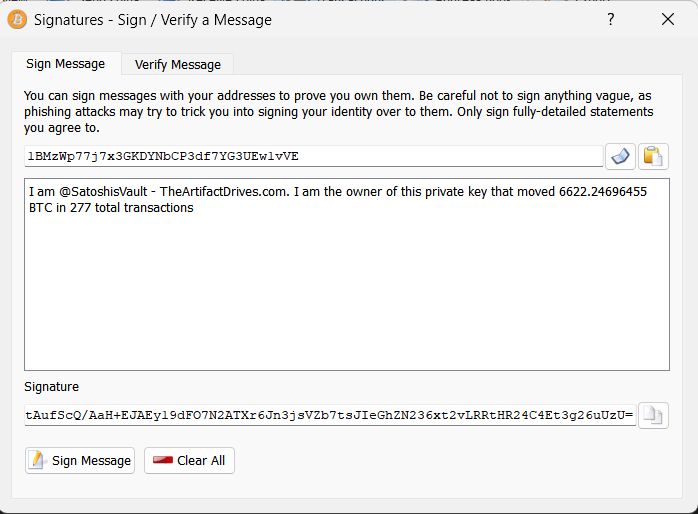
EVIDENCE_LOG_V.0.8.1Signature Generation
The original signature-generation dialog inside Bitcoin-Qt v0.8.1-beta. The embedded wallet.dat contains the private key used to produce this signature. Note the "recommended" transaction fee of 0.01 BTC—a historical artifact representing thousandths of a penny at the time, but thousands of dollars today.
Cryptographic Verification
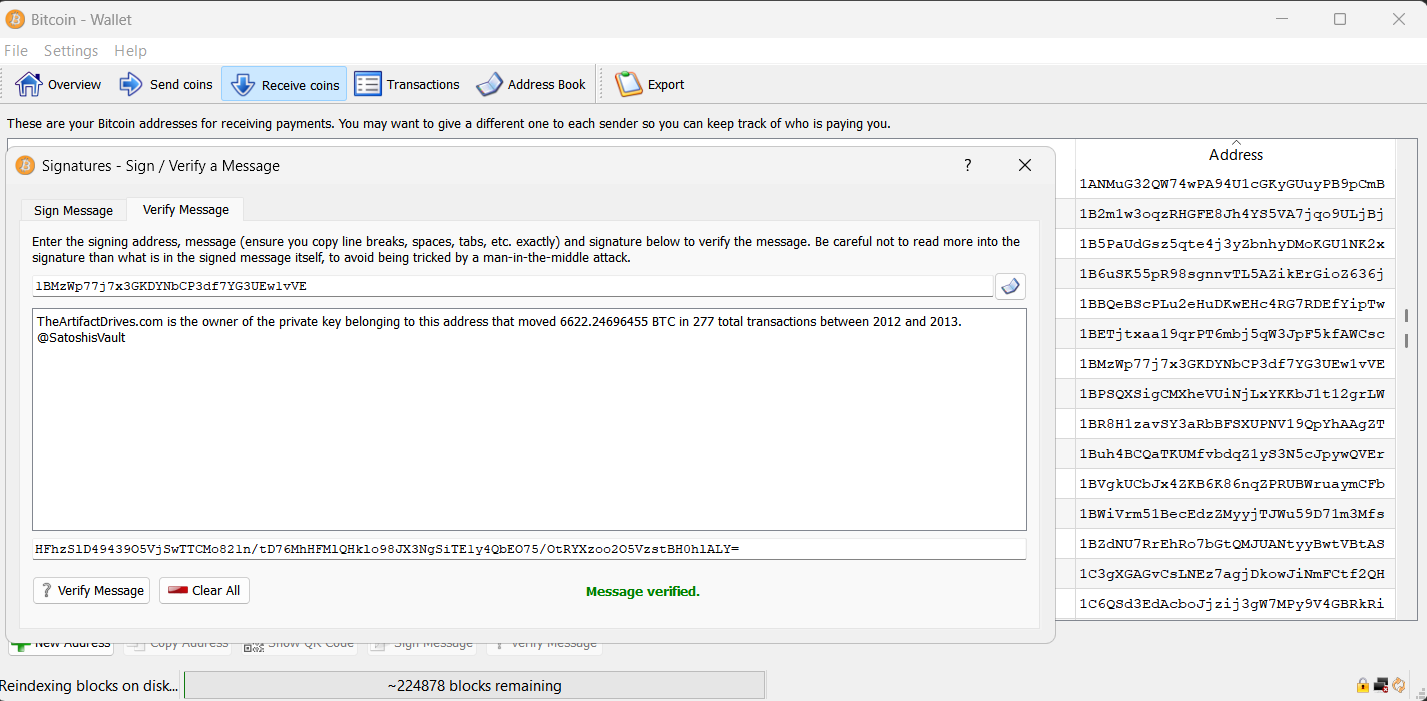
Verification performed within the same preserved client confirms the signature as valid. This result establishes cryptographic continuity and proves that the embedded wallet is genuinely tied to the high-value transactions executed between 2012 and 2013.
Client Provenance
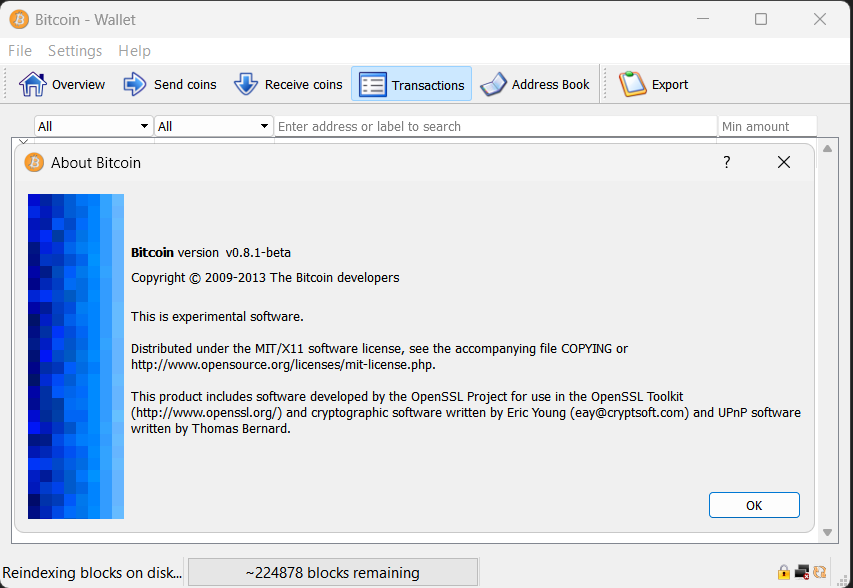
The "About" dialog confirms the client as "Satoshi" Bitcoin-Qt v0.8.1-beta. This build corresponds to a transitional phase in Bitcoin's development. Notably, this era of Bitcoin‑Qt featured an embedded wallet that supported only single‑key extraction and displayed the early Security UI prompting for an **“8 words or more” passphrase**, a historical artifact from the pre‑HD, pre‑descriptor era when wallet encryption was first being introduced. The drives are confirmed to have one owner, one user profile, with only one daily user throughout the life of the hardware.